

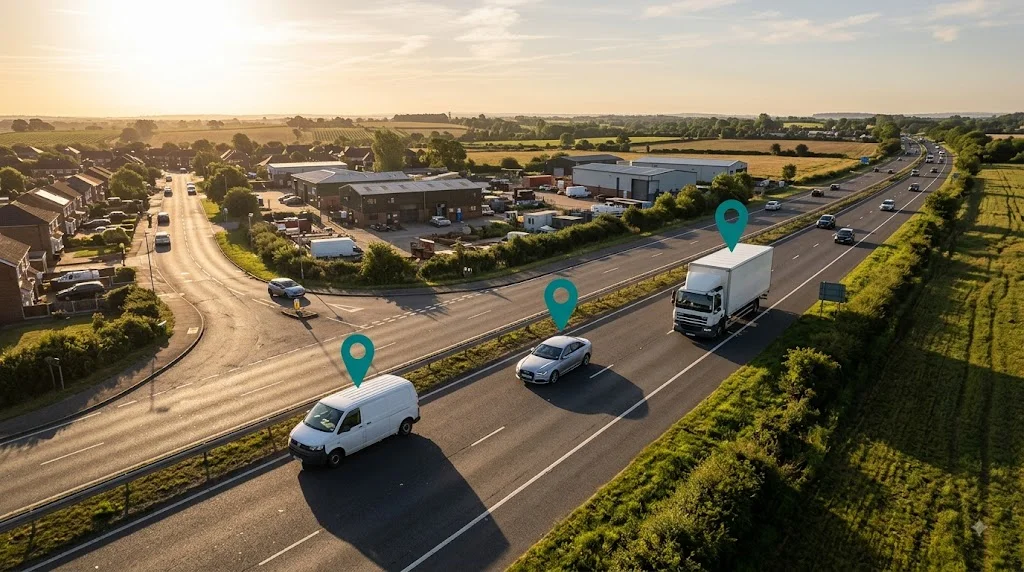
How to Track a Mixed Fleet of Cars, Vans and Trucks in Real Time
Charles
Fleet managers, are you still guessing where your cars, vans, and trucks are?
If the honest answer is yes, you are not alone, and you are not badly run. Plenty of capable operators coordinate a fleet from memory, a group chat, and the occasional phone call. It holds together right up until it does not: a vehicle goes missing, a customer disputes a delivery time, a driver takes a route that costs you an hour and a tank of fuel, and suddenly you are reconstructing the day from guesswork. This post walks through how to track a mixed fleet in real time from nothing more than a laptop or a phone, and why knowing where every vehicle is, at any moment, changes how you run the whole operation.
Guessing is a cost, not a habit
Not knowing where your vehicles are feels like a minor inconvenience. It is actually a running cost, paid in several currencies at once.
You pay in time, because every question about your own operation turns into a phone call and a wait. You pay in fuel, because inefficient routing and unnecessary trips only become visible after the fact, if at all. You pay in risk, because a vehicle you cannot locate is a vehicle you cannot protect. And you pay in credibility, because a customer who asks where their van is deserves a better answer than “let me find out and call you back.”
For a mixed fleet the guessing gets harder, not easier. Cars, vans and trucks move differently, serve different jobs, and often run on different schedules. Trying to hold all of that in your head across even a dozen vehicles is a losing game. The manager in the walkthrough below runs 15 vehicles, 5 trucks, 5 vans and 5 cars, from a single screen, and the point is not the number. It is that the type and mix stop mattering once everything reports to one place.
Watch: tracking a 15-vehicle fleet from one screen
Charles from Traknova walks through exactly how he keeps eyes on his mixed fleet using just his laptop or phone.
What you get with real-time tracking
Three capabilities do most of the heavy lifting. Individually they are useful. Together they replace guessing with knowing.
Live vehicle tracking
Every vehicle appears on one map in real time, wherever you are. You do not need to be at a desk or even in the same country. Open it on your laptop at the yard or on your phone at home and the picture is the same: who is where, right now. For a mixed fleet that means the trucks on long runs, the vans on local jobs, and the cars in daily use all sit in a single view instead of living in your head.
Detailed trip playback
Live location answers where a vehicle is. Trip playback answers where it has been. You can replay a vehicle’s day in full, following the exact route it took, the stops it made, and how long each one lasted. This is what settles disputes, whether a customer says a delivery never arrived or a driver’s account of the day does not add up. Instead of arguing, you replay it.
Full telematics data
Underneath the map sits the detail: speed, mileage, routes, and more. This is the data that turns tracking from a location tool into a management tool. Mileage tells you which vehicles are being worked hardest and which are underused. Speed and route data flag habits that cost you in fuel, wear, and risk. Over time it is the raw material for running a leaner, safer fleet rather than just a visible one.
Who this is for
Real-time tracking is not only for large logistics operations. The same setup works across very different situations.
Businesses running a working fleet. If your vehicles are how you deliver, service, or supply, then visibility is directly tied to how well you operate. Better routing, honest ETAs, and accurate records feed straight into cost and customer trust.
Turo hosts and rental operators. When your vehicles are out with paying customers, tracking is protection. You know where your cars are, you can verify usage against what was agreed, and you have a clear record if something goes wrong. If that is your world, our guide on automating your Turo business goes further on running it hands-off.
Owners of high-value or personal vehicles. Even outside a commercial setting, knowing a vehicle’s exact location and being able to review its movement is real peace of mind, and real security if it is ever taken.
Managing from anywhere
The quiet shift here is where management happens. Traditionally, keeping tabs on a fleet meant being physically close to it, at the depot, on the phone, chasing. Real-time tracking cuts that tie. Because everything lives on a platform you reach from a browser or your phone, you can run the fleet from the office, from home, or from the other side of the world.
That matters more than it sounds. It means a manager is not a bottleneck who has to be present to answer basic questions. It means problems get spotted early rather than at the end of the day. And it means the operation keeps running with the same visibility whether you are standing in the yard or sitting on a train.
Turning visibility into control
Seeing your fleet is the start. The value comes from what you do with what you see.
With live positions in front of you, you assign the nearest vehicle to a new job instead of the one you happened to think of. With trip playback, you resolve disputes in minutes and build an honest record of what your fleet actually does. With telematics, you find the routes, habits and vehicles that quietly drain money, and you fix them. Each of these reduces operational risk, and together they protect every vehicle in the fleet around the clock.
The mix stops being a complication. Cars, vans and trucks all report to the same place, on the same map, with the same detail behind them, so managing 15 mixed vehicles feels less chaotic than managing 5 by phone.
Summary and next steps
If you are still guessing where your vehicles are, you are paying for it, in time, fuel, risk and reputation, whether or not it shows up as a line on an invoice. Real-time tracking replaces that guessing with a single, live picture of your entire fleet that you can reach from anywhere. It works across cars, vans and trucks, and it scales with you, so the day you add your sixteenth vehicle feels no different from managing your first.
For more, see our fleet management and GPS tracking solutions, and our practical guide to fleet GPS tracking for UK operators if you want a deeper look before you commit.