

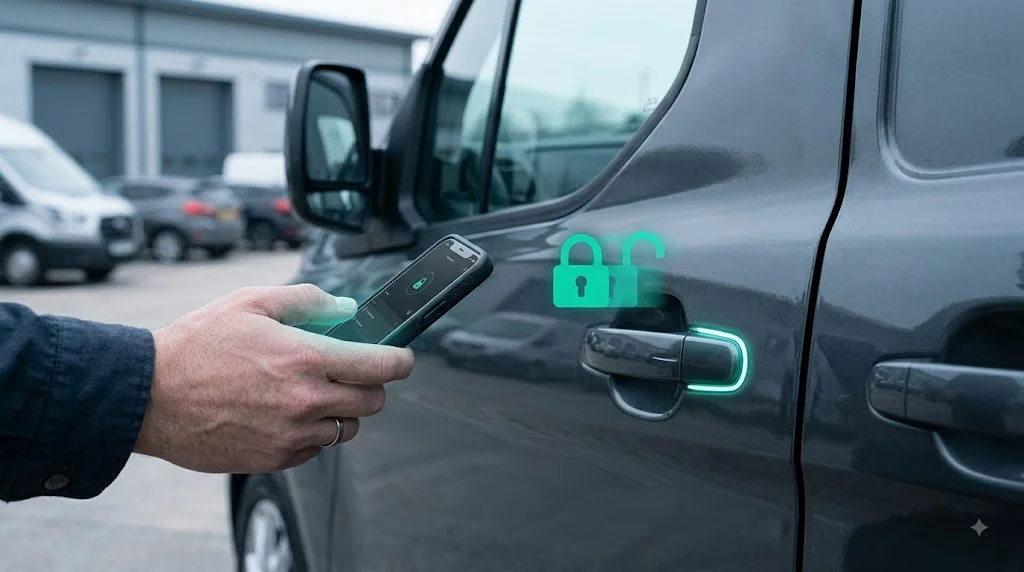
How to Remotely Unlock Any Vehicle in Your Fleet, No Keys
Charles
Lost keys. Lockouts. Missed deliveries. Every one of them stops a vehicle, and a stopped vehicle costs you money.
For most fleets, physical keys are a quiet bottleneck. They get lost, locked inside, handed to the wrong person, or left at the wrong site. Each incident means a delay, often a callout, and sometimes a whole job that does not happen. Remote access removes the key from the equation. With Traknova’s remote access feature you can unlock any vehicle in your fleet, from anywhere, using just your phone or laptop. This post explains how it works, where it saves you time and money, and how it doubles as a genuine security tool.
The hidden cost of keys
A key seems like the simplest part of a fleet. It is also one of the most disruptive when it goes wrong, because the failure always lands at the worst moment.
A driver locks the keys inside a van on a delivery round, and the whole route stalls while someone drives out with a spare. A rental customer arrives to collect a car and the key handover does not line up, so they wait, and your first impression is a delay. A set of keys goes missing and a vehicle sits idle until it is found or replaced. None of these are dramatic on their own, but they share the same shape: a vehicle that should be earning is instead stuck, and someone is spending time and money getting it moving again.
Callouts are the visible cost. The bigger one is the downtime and the damage to your reliability, especially in rental and delivery, where being on time is the product.
Watch: unlocking a vehicle remotely
Here is a walkthrough of unlocking cars, vans and trucks remotely, straight from the platform.
What remote access lets you do
Remote access is not a single trick. It is a set of controls that put the lock, and who can use it, entirely in your hands.
Unlock any vehicle in seconds
Cars, vans and trucks all respond to the same platform. From your phone or laptop, you send an unlock command and the vehicle opens, wherever it is. A lockout that used to mean a callout and a wait becomes a few seconds of work from wherever you happen to be.
Eliminate costly delays and callouts
Because you no longer need to physically reach a vehicle to open it, a whole category of expense disappears. No spare-key runs, no locksmith, no route stalled while someone drives out with a replacement. The vehicle keeps working, and so does everyone waiting on it.
Give renters instant access by mobile link
For rental and car-sharing operators, this is the standout. Instead of coordinating a physical key handover, you send the customer a mobile link that lets them access the vehicle themselves. Collection becomes contactless and immediate, which is exactly what customers now expect. If you run on platforms like Turo, our guides on Turo keyless and Turo remote access go deeper on running this hands-off.
Keep full control with secure, encrypted commands
Handing out access only works if it is safe, so every command runs through secure, encrypted channels. You are not trading control for convenience. You get both, with the confidence that only authorised commands reach your vehicles.
Revoke access or override at any time
Access is never permanent unless you want it to be. You can revoke a customer’s access the moment a rental ends, or override and take back control at any point. That means a vehicle is only ever open to the right person for exactly as long as it should be.
Who this is built for
Remote access earns its place fastest in operations that cannot afford to slow down.
Rental fleets get contactless collection and return, instant handovers, and access that starts and ends exactly with the booking. It removes the single most awkward part of the rental experience and makes the whole thing feel modern. This is core to how we think about car rental.
Delivery and logistics vehicles get protection against the lockouts and key mix-ups that stall a route. When time-critical drops depend on a vehicle staying moving, removing the key as a failure point is a direct win.
Business operations of all kinds get the flexibility of opening a vehicle for the right person without anyone having to be physically present with a key. Shared pool vehicles, multi-site teams, and out-of-hours access all get simpler.
Bonus: prepping for remote immobilisation
Remote access is one half of a bigger idea: controlling your vehicles from a distance. The other half is being able to stop them. The same setup that lets you unlock a vehicle also lets you prepare for remote immobilisation, so that in the event of theft or serious misuse you are not limited to watching a vehicle move on a map.
That is total control in the situation that matters most. You can grant access to the right person in seconds, and you can deny movement entirely to the wrong one. If security is the priority, our immobilisers page covers how that layer works alongside remote access.
A note on doing it safely
Powerful remote controls come with responsibility. Access should be granted only to the right person, for the right vehicle, for the right window of time, and revoked promptly when it is no longer needed. Encrypted commands and the ability to override at any time are what make this safe in practice, but the discipline matters too. Used well, remote access is both more convenient and more secure than a drawer full of physical keys, because you always know exactly who can open what, and you can change it instantly.
Summary and next steps
Keys are a small thing that cause big delays. Lost keys, lockouts and missed handovers stop vehicles, trigger callouts, and chip away at the reliability your customers are paying for. Remote access removes the key as a point of failure. You unlock any vehicle in seconds from your phone or laptop, hand customers instant access by link, keep every command secure, and revoke or override whenever you need to. And because the same control extends to immobilisation, you get convenience and security from a single platform.
For more, see our keyless and immobilisers solutions, and how it all comes together for car rental operators.