

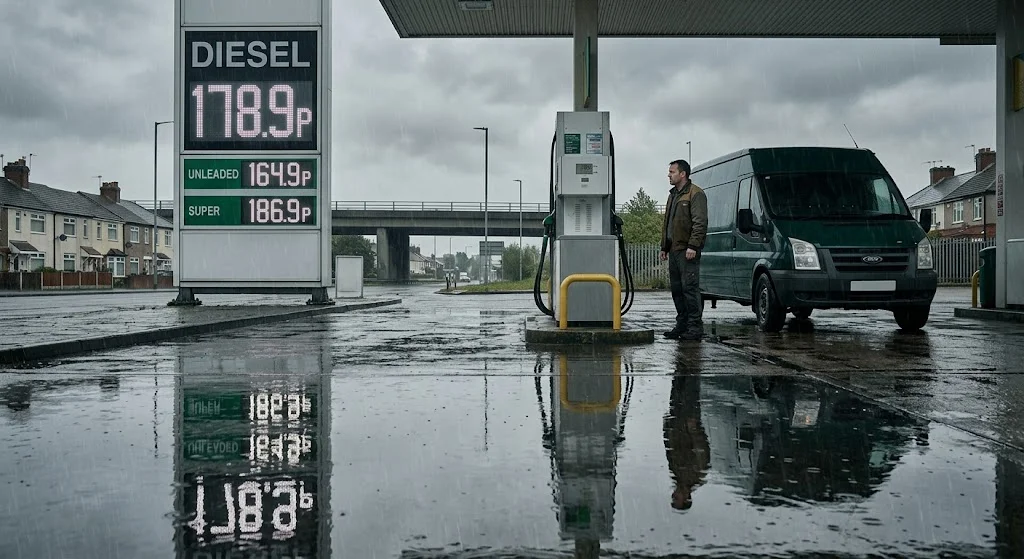
How to Cut Fleet Fuel Costs as UK Pump Prices Climb
Timi
Most fleets are burning 10 to 15% more fuel than they need to. Not because of the pump price — you cannot control that — but because of the idling, the wandering routes and the heavy right feet that tracking makes visible and fixable. With diesel above 174p and no relief coming, those litres are where the fight is.
Why chasing cheaper fuel barely moves the needle
Most operators respond to high prices by hunting cheaper forecourts. It is worth doing, but understand the ceiling on it.
Roughly 55 to 60% of what you pay at the pump is fixed tax. Fuel duty and VAT do not move when oil prices fall. That is why a 10% drop in crude might only knock 4 to 5% off the pump price. The wholesale cost, delivery and the retailer’s slim margin make up the rest.
Supermarket forecourts typically undercut the national average by 3 to 8p a litre, and motorway services gouge you by 15 to 20p. Shopping smart saves you pennies per litre. Useful, but small.
The bigger prize is the fuel you never needed to buy in the first place. A penny off the price is a rounding error next to a percentage off the litres burned, and the litres are the part you actually control.
Why this matters more in 2026
Fuel is 25 to 35% of total operating costs for most fleet-dependent businesses. When diesel jumps 30p a litre in a few months, as it did between January and April 2026, that is not a rounding error on your margin. It is the difference between a profitable quarter and a painful one.
And the volatility itself is the point. Prices have swung violently all year on geopolitics no operator can predict. Building your margins around a hoped-for price drop is not a plan. Cutting consumption is, because a 10% reduction in litres is worth the same whether diesel is 150p or 190p, and it keeps paying back every week prices stay high.
Where fleet fuel actually leaks
The waste hides in three places, and all three are visible and fixable once you have the data.
Idling
An engine running while the vehicle is stationary burns fuel and earns nothing. Across a fleet it is one of the largest and most invisible costs you carry, because no single instance looks like much. A van idling for an hour a day, five days a week, across a fleet of fifteen, adds up to a serious annual number that never appears as a line on any invoice.
Tracking shows you idling broken down by vehicle and by driver. Once you can see it, you can set a policy, coach the worst offenders and watch the number fall. This is usually the fastest win available.
Inefficient routing
Every unnecessary mile is fuel you did not need to buy, plus the wear and the driver time that came with it. Poor sequencing, backtracking and drivers taking the route they have always taken rather than the efficient one add up fast over a week.
Route data and live location let you plan tighter, dispatch the nearest vehicle and stop paying for miles that earned nothing. For a fleet doing reactive or multi-drop work, this is often the single biggest fuel lever.
Driver behaviour
Harsh acceleration and heavy braking hammer economy. The same van driven two different ways can vary by double digits on MPG. Speeding compounds it, because fuel consumption climbs sharply above about 60mph.
Behaviour data turns this from a hunch into something you can manage. You see which drivers are costing you, you coach them, and the smoother driving that results also cuts wear, accidents and insurance risk. It is the saving that keeps giving.
A worked example
Take fifteen vans, each covering 15,000 miles a year at 35mpg, with diesel at 174p a litre.
That works out to roughly 1,948 litres per vehicle a year, or about 3,390 pounds per van, so around 50,800 pounds across the fleet.
Now apply a conservative 12% reduction, split across idling, routing and behaviour. That is roughly 6,100 pounds a year, recovered without winning a single new customer or buying a drop of cheaper fuel. Stretch the reduction toward the 15% that well-run fleets achieve and you are north of 7,600 pounds.
Your numbers will differ, but the shape holds. Small percentages off a large, weekly cost compound into real money.
A practical order of attack
- Measure first. You cannot cut what you cannot see. Get idling, routing and behaviour data flowing before you change anything.
- Kill idling. It is the quickest, least controversial win. Set a clear policy and share the league table.
- Tighten routing. Dispatch the nearest vehicle and plan multi-drop routes properly rather than by habit.
- Coach behaviour. Focus on the handful of drivers responsible for most of the harsh events. Small changes, big fleet-wide effect.
- Then optimise fuel buying. Once consumption is under control, layer on smarter forecourt choices for the last few percent.
Frequently asked questions
How much can I realistically save on fuel? Fleets starting from no visibility commonly see 10 to 15% off the fuel bill once they act on idling, routing and behaviour data. Already-disciplined fleets save less because there is less waste to remove.
Does this apply to electric vehicles? The routing and behaviour principles carry straight over to energy use and range. Idle waste changes shape but efficient driving still matters.
Will drivers push back? Framed as fairness and safety rather than surveillance, most drivers accept it, especially when the data also backs them up in disputes.
Summary
Pump prices are high, volatile and outside your control, and the tax that makes up most of the price is not going anywhere. The litres your fleet burns are the part you own. Focus on idling, routing and driver behaviour, and the savings hold up whatever happens to the price of a barrel.
Put a number on your own fleet with our Fuel Savings Calculator, which splits the saving across idle, routing and behaviour so you can see where the money is. See how our fleet management platform surfaces fuel waste, or book a demo and we will benchmark your fleet.