
What It Really Takes to Build Telematics Software From Scratch
Charles Alexis
Every few months, someone decides the tracking software they are paying for is too expensive and that they could just build their own.
On paper it looks simple. Buy some trackers, put the dots on a map, done. Then the reality arrives: the dots lie, the server falls over at 2am, and half your devices go dark when a network gets switched off. Telematics is one of those products that looks like an app and is actually a stack of hard engineering problems stitched together.
This is an honest look at everything that goes into building it, so you can decide whether it is worth your time or whether buying is the smarter move.
Telematics is a stack, not an app
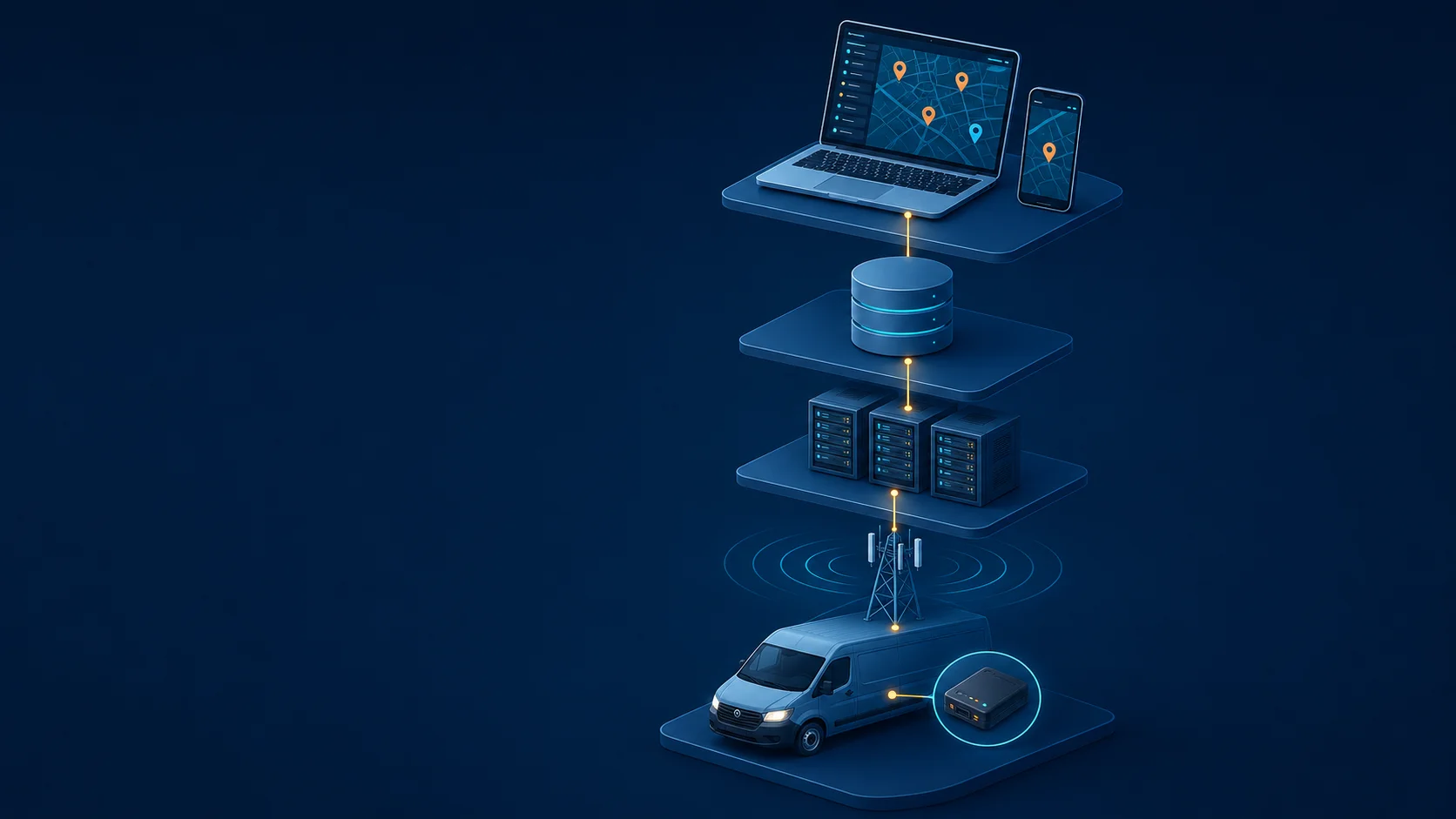
Before the components, the mindset. A working telematics platform is really five systems that all have to work at once: the hardware in the vehicle, the connectivity that carries its data, the servers that receive and process it, the storage that keeps it, and the software that turns it into something a human can act on.
Weakness in any one of those breaks the whole thing. A beautiful dashboard is useless if the device stops reporting in a tunnel. Let us go through them in order.
The hardware problem
If you are not using the connectivity already built into modern vehicles, you need a physical device, and this is where most projects underestimate the work.
A tracker is not just a GPS chip. A usable unit needs several parts working together:
- A GNSS module for positioning, ideally using GPS, GLONASS and Galileo for accuracy.
- A cellular modem to send data, on 4G, LTE-M or NB-IoT.
- A microcontroller, memory and an accelerometer for motion and driving events.
- A connection to the vehicle, either through the OBD port or wired into the CAN bus to read ignition, mileage and fault codes.
- A backup battery, a rugged enclosure, and power management that survives the messy electrical environment of a vehicle.
Then comes the part people forget. Any device that transmits on mobile networks needs certification before you can legally sell or even run it at scale, including UKCA and CE marking and approval to operate on carrier networks. That is a slow, expensive process, and it happens before you have shipped a single unit.
You also have to write and maintain firmware, and update it over the air without turning a fleet of devices into bricks. Sourcing, testing and supporting physical hardware is a business in its own right, separate from the software.
There is a reason a growing number of operators skip hardware entirely and use digital tracking that pulls data from connectivity already in the vehicle. No device to source, certify, fit or replace.
Getting the data off the device
Say the hardware works. Now the device needs to talk to your servers, and here is the catch: trackers do not send tidy JSON. Most speak their own compact binary protocols, and every manufacturer does it differently. Popular devices from vendors like Teltonika, Queclink and Concox each use their own message formats, so you write and maintain a parser for every device type you support.
Devices also hold a persistent connection open rather than making neat one-off requests, and when a vehicle loses signal the device stores its data and dumps it all at once when the connection returns. Your system has to accept that backlog, keep it in order, and never drop a packet.
Servers and the ingestion layer
The piece that receives all this is the ingestion layer, and it is the hardest part to get right. It has to hold thousands of open connections at the same time, one for every active vehicle, handle constant reconnects, decode each message, and pass it on for processing.
If that layer goes down for ten minutes, you do not just have a blank map. You lose ten minutes of data from your entire fleet, permanently, because that moment has passed. This usually means a message queue to buffer everything, a processing service behind it, and an API for the app to read from. None of it can take a night off.
Data storage
A single vehicle reporting its position every few seconds produces an enormous amount of data. Multiply that across a fleet, running around the clock, for years.
A normal database is not built for that write volume, so most serious systems use a time-series database for the location history, plus geospatial tooling to handle things like geofences and “which vehicles are near this point” queries. You then need a retention policy, because keeping every raw ping forever gets expensive quickly, and customers will still expect to pull up a trip from eight months ago in under a second.
Hosting, uptime and scale
All of this has to run somewhere, reliably, forever. Telematics is not a service people tolerate being down. If a vehicle is stolen at 3am, “we had an outage” is not an acceptable answer.
That means proper cloud infrastructure, monitoring, automatic scaling as you add vehicles, backups, and someone on call when it breaks. The hosting bill is real and it grows with every device, whether or not you are charging enough to cover it.
Live field testing: the part that breaks you
Everything above can pass in the lab and still fall apart in a real vehicle. Field testing is where telematics projects quietly die.
Real conditions throw problems you cannot predict from a desk:
- GPS drifts and jumps, so a parked van appears to wander down the street, firing false alerts.
- Vehicles go through tunnels and underground car parks and vanish, then reappear.
- Detecting ignition on and off accurately across different makes is genuinely fiddly.
- Voltage spikes and cheap wiring can reboot or damage devices.
- A firmware update that worked on the bench can knock out a device fitted deep in a dashboard.
You only find these by fitting devices to real vehicles and driving them for weeks. Then you tune, and test again. Getting alerts trustworthy enough that people do not ignore them takes far longer than building the alerts themselves.
The features you will be expected to have
Even a “basic” tracking product is compared against mature platforms, so the baseline expectation is high. At minimum, customers will want:
- A live map with accurate vehicle positions.
- Trip history and playback.
- Geofencing with enter and exit alerts.
- Real-time notifications for events like speeding, movement or a door opening.
- Reports on usage, mileage and driver behaviour.
- User roles and permissions for teams.
- Mobile apps, not just a web dashboard.
And that is before the features that actually differentiate a platform, such as immobilisers and remote lock control, dash camera footage, and proper fleet management tooling on top.
The costs nobody budgets for
The build is the cheap part. What follows is the expensive part.
Networks change under you. The UK’s 3G networks have now been switched off, and the 2G networks are scheduled to shut down from 2029 onwards, with everything gone by 2033 at the latest. Any device built on older connectivity becomes e-waste on someone else’s timetable, and you carry the cost of replacing a whole fleet’s worth of hardware.
Then there is security, because a device that can immobilise a vehicle is a serious target, and a breach is a nightmare. There is data protection, since location data is personal data under UK GDPR, which brings consent, retention and compliance obligations. And there is support, because customers will call when a device stops reporting, and someone has to answer.
What the people who have tried it say
You do not have to take my word for it. Spend ten minutes in any startup or small-business forum and the same story plays out on repeat.
A developer with solid general coding experience gets asked by a friend to build a fleet system for their logistics company. The plan is often to turn it into a SaaS and sell it to other operators later. Then the questions start, and they are not about code. They are about which hardware to pick, what the architecture should be, and where on earth to even begin.
The people who reply with real experience tend to land on two points. The first is that you have to choose your hardware before you write a line of software, because everything downstream depends on it. The second, which comes up again and again, is that the software is not the hard part. One developer who spent six years building transport management systems made the point plainly: building the system is manageable, but getting people to actually adopt and stick with it is where these projects live or die.
An ex-supervisor who ran fleet operations for a major parcel carrier was blunter about the SaaS dream. Too many moving parts, constant updates, and rules that shift by region, from weight limits to driver hours, so the software has to keep chasing the law forever.
That last point is the one to sit with. The expensive part is never version one. It is maintaining version one against a world that will not stop moving.
Build versus buy
None of this means building is always wrong. It comes down to what you actually are.
| Building your own | Buying off the shelf | |
|---|---|---|
| Best for | Businesses whose core product is telematics | Operators who need tracking to run their fleet |
| Time to running | Many months to a year plus | Days |
| Upfront cost | High and mostly hidden | Predictable subscription |
| Ongoing burden | Yours forever | The provider’s |
| Focus | Split between your business and infrastructure | Stays on your business |
If your company’s product is telematics, build it, because that is the business. If you run a taxi firm, a rental operation or a logistics fleet, every month spent building infrastructure is a month not spent on the thing that actually makes you money.
Summary and next steps
Building telematics software means building hardware, connectivity, ingestion, storage, hosting and a full feature set, then maintaining all of it while networks and regulations shift underneath you. It is a real engineering programme, not a side project.
For most operators, the maths is simple. Someone has already built it, tested it in the field for years, and carries the ongoing cost so you do not have to. That someone is us.